A federation of seven emirates formed in 1971 when Britain left the Gulf, the UAE is ruled by hereditary emirs, with Abu Dhabi’s Al Nahyan family holding the presidency. Oil wealth funded rapid modernization in Dubai and Abu Dhabi, while political power stays with the rulers. Under Sheikh Mohamed bin Zayed it has become an assertive regional power, and it normalized relations with Israel in 2020.
United Arab Emirates today
Its current leader’s position on the ten Caucus dimensions.
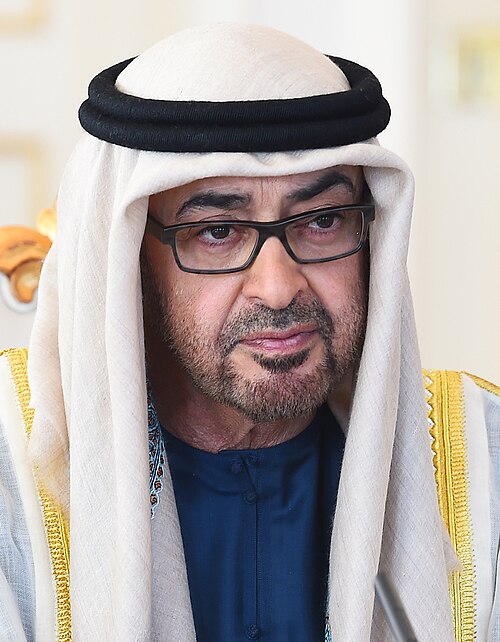
President of the United Arab Emirates, 2022 to present
Effectively ran the UAE for years before becoming president in 2022, steering the country toward technology, finance and an assertive foreign policy while tightly limiting dissent.
Mohamed bin Zayed Al Nahyan sits in the right-authoritarian part of the Caucus economy and liberty compass: centered on economy and strongly authoritarian. The clearest positions are strongly authoritarian on liberty and authority, strongly tech-optimist on technology and strongly interventionist on interventionism. The profile is close to the middle on economy and environment.
Country histories are short summaries. Positions are simplified estimates of the leaders included in Caucus as of October 2026, and percentages show how close two profiles are across all ten dimensions.
Support Caucus
Caucus is free, has no ads and collects nothing about you. If it helped you learn something, you can chip in with crypto.
Our goal is simple: to help people understand politics, not just react to it. Democracies work better when citizens can tell a policy from a slogan, know where leaders actually stand and are able to meet ideas they disagree with. Political literacy is what protects us from manipulation and polarization, and it is the first step to taking part in public life. Caucus turns ten dimensions, hundreds of leaders and thinkers and every country's political history into something you can explore in minutes, and keeps it free and private for everyone. Your donation keeps it independent, ad-free and growing.
Bitcoin
BTC · Bitcoin network
bc1qwelwgls696z3gjgx2x9tj2hj7kdy5t0k887wed
Ethereum
ETH · Ethereum network
0x743b3c61b176aacB4ec2cc409992e37675e87D1C
Solana
SOL · Solana network
FbrjwgdExzcssqLJmytYaNYMpQ7MgmMzmbWk35rLyd3h
Stablecoins and EVM coins
USDT · USDC · BNB · POL · Ethereum, Base, Arbitrum, Polygon or BNB Chain
0x743b3c61b176aacB4ec2cc409992e37675e87D1C
Check that the network matches before sending: funds sent on the wrong network cannot be recovered.